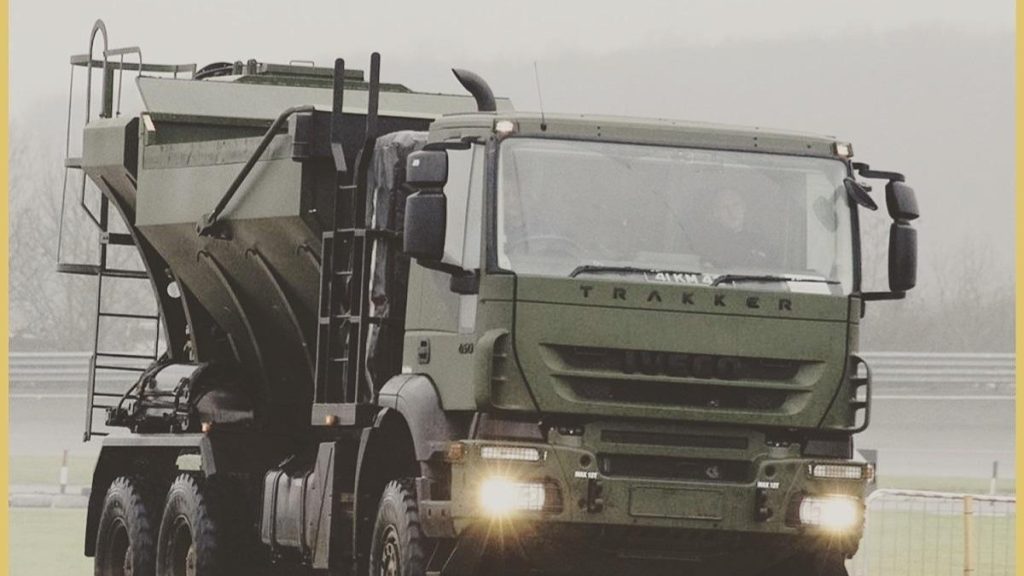
Volumetric Concrete Mixers (VCMs) are mobile concrete production machines that transport raw materials—sand, aggregates, cement, water, and admixtures—allowing concrete to be mixed on-site as needed, with minimal waste. These mixers have played a crucial role in Airfield Damage Repair (ADR), a key capability for restoring airfields to operational status following damage.
For military operations, airfields are essential infrastructure, facilitating aircraft take-offs and landings for offensive, defensive, and logistical missions. The rapid repair of airfield damage is, therefore, a priority for armed forces worldwide. The British Army has relied on a fleet of VCMs for ADR since 2010, with the units initially designed and manufactured by Nurock Mixers in Liverpool, UK. These mixers were built to meet specific military requirements, including off-road capability, and were further supported by NATO codification of all parts, the production of Army Equipment Support Publications, and training beyond that provided for commercial off-the-shelf equipment.
The procurement of these mixers was part of a Public Finance Initiative (PFI), in which private companies owned assets that were leased to the Ministry of Defence (MoD) along with associated services and support. Nurock Mixers secured the contract through ALC (SPC) Ltd, which managed construction equipment for the MoD under a £600 million, 15-year agreement. The fleet is now owned by a joint venture between Amey and Briggs Equipment under Project MITRE, a £240 million defence contract.
These VCMs have been deployed both in the UK and internationally for operational and training purposes. As the fleet continues in service, KC3 has been commissioned to upgrade the mixers to align with the specifications of current KC3 models and for them to continue to be fully supported. Enhancements include improved hydraulic systems for faster mixing speeds and other refinements based on user feedback. Despite being in service for over 15 years, the fleet remains very reliable—a credit to its robust, simple design and first-class maintenance by the asset owner.
A key factor in the original selection of VCMs for ADR was their ability to work with rapid-set cement, such as Tarmac PQX. This allowed for high early-strength concrete to be produced. During initial trials being part of a three-year tender process, the Nurock Mixer outperformed competitors, delivering concrete strong enough to support the landing of a fully armed Tornado fighter jet within three hours of pouring.
Despite their effectiveness, the VCM industry has faced significant regulatory challenges in recent years. In the UK, VCMs have been in use since 1975, providing on-demand concrete mixed to precise specifications. However, their heavier weight compared to traditional drum mixers has led to government-imposed weight restrictions. In 2018, a phased ban on VCMs exceeding 32 tonnes was introduced, posing a threat to the £380 million-per-year industry and the 15,000 skilled jobs it supports.
Concerns regarding the future of VCMs were raised with the UK Defence Select Committee in 2024. Members acknowledged the importance of maintaining the MoD’s ability to conduct urgent infrastructure repairs and requested ongoing updates on industry developments. Meanwhile, the U.S. Department of Defence continues to operate a large fleet of VCMs, which remain integral to its Rapid Airfield Damage Recovery (RADR) programme.
More than 50 years after Harold Zimmerman, a Pennsylvania farmer, invented the first VCM, the industry continues to evolve. Modern VCMs incorporate advanced features to enhance performance, yet the fundamental concept—combining batching, mixing, and delivery into a single machine—remains a remarkably effective solution.